
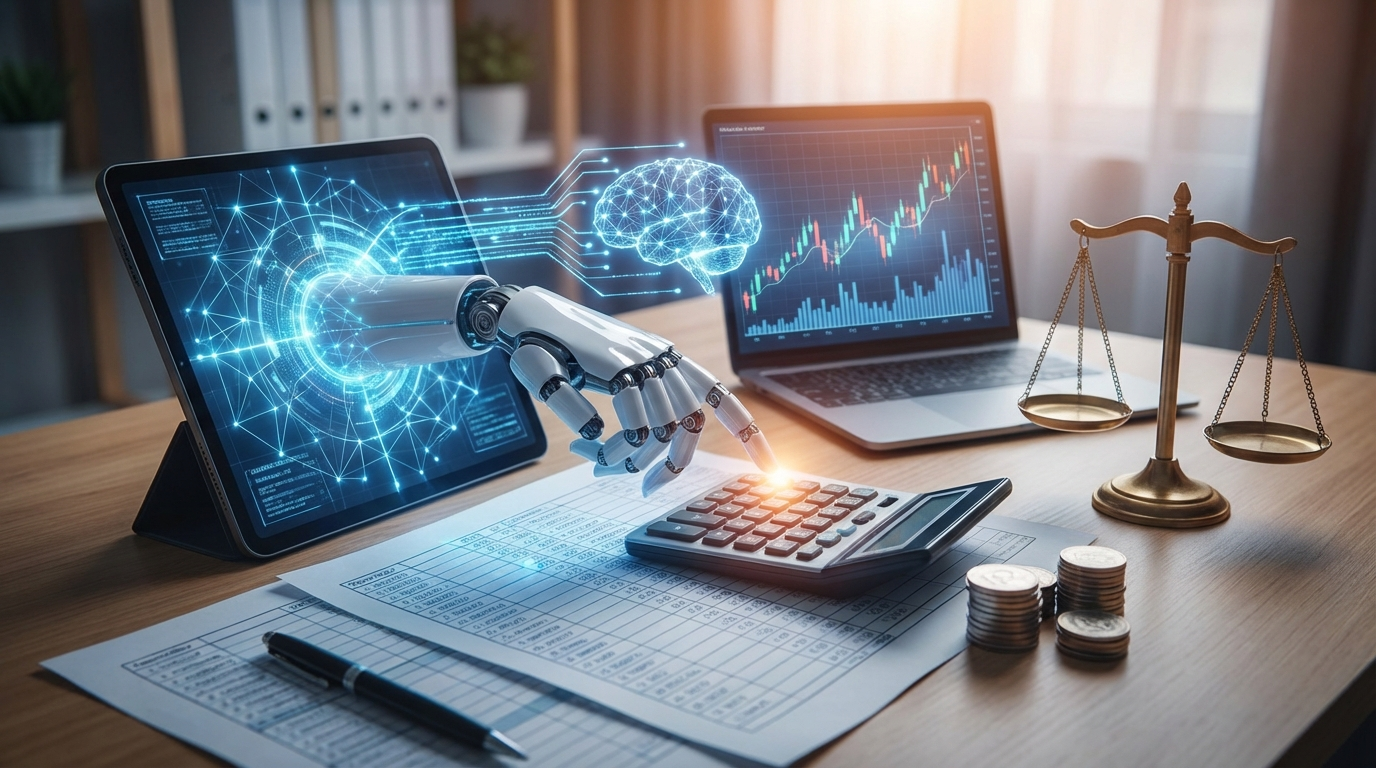
AI for accounting is rapidly reshaping how financial professionals work analyze data and deliver value to their clients. What was once a field dominated by manual data entry repetitive reconciliations and time intensive audits is now being transformed by intelligent automation real time analytics and predictive insights. As businesses demand faster reporting stronger compliance and deeper financial intelligence AI is becoming an essential tool rather than a futuristic add on. This article explores how AI for accounting is transforming the industry from routine task automation to strategic decision making while improving accuracy productivity and cost efficiency.
How AI is Transforming the Accounting Industry
Estimated reading time: 5 minutes
- AI automates mundane tasks, allowing accountants to focus on strategic work.
- Enhanced financial analysis through real-time insights and predictive analytics.
- AI significantly improves fraud detection and compliance auditing.
- Overall productivity and cost savings are achieved through AI integration.
Table of Contents
- Automation of Routine Tasks
- Financial Analysis and Strategic Insights
- Enhanced Fraud and Anomaly Detection
- Audit Process Improvements
- Document and Research Support
- Overall Productivity and Cost Benefits
- Practical Takeaways and Actionable Advice
Automation of Routine Tasks
One of the foremost advantages of AI in accounting is the automation of routine tasks, which allows accounting professionals to redirect their focus to higher-value strategic work. Traditional data entry and document processing are some of the most time-consuming tasks that AI can revolutionize.
Data Entry and Document Processing
AI technology now enables the reading and interpretation of financial documents, fundamentally eliminating manual data entry. This advancement allows accountants to analyze extensive datasets with greater accuracy and speed, reducing human error. As noted in a resource from DataSnipper, this reduction in manual workload is especially crucial for larger organizations that deal with complex data setups.
Invoice Processing and Expense Management
Automated systems powered by AI can process invoices by interpreting them, matching them with corresponding purchase orders, and finally processing payments electronically. According to Tipalti, AI also categorizes expenses automatically while flagging any irregularities, thus enhancing oversight and mitigating the risk of fraud.
Accounts Payable and Receivable
Robotic Process Automation (RPA) forms a crucial component in the accounts payable ecosystem by matching supplier invoices with purchase orders, ensuring compliance with company policy. Similarly, AI aids in accounts receivable by validating invoices and automatically posting them to revenue accounts, as highlighted by NetSuite.
AI for accounting: Financial Analysis and Strategic Insights
AI is not just transforming routine tasks but is also pushing the boundaries of financial analysis and strategic insights.
Forecasting and Budgeting
AI algorithms analyze historical data to identify trends, enabling accountants to make precise forecasts about upcoming financial patterns. According to DataSnipper, this technology plays a crucial role in developing accurate budgets and exploring various financial scenarios. AI can provide suggestions on optimizing tax strategies as well.
Real-Time Business Intelligence
AI generates real-time insights and predictive analytics, allowing accountants to deliver actionable strategic advice. With the capabilities to monitor financial performance continuously and detect potential challenges proactively, AI-assisted analysis presents a deeper business insight than traditional manual methods, as observed on NetSuite.
Financial Reporting
AI’s ability to swiftly analyze large datasets enables the timely generation of customized financial reports. The capability to visualize data through graphs and visualizations helps accountants communicate their findings more effectively to stakeholders, enhancing understanding and decision-making (Karbon).
Enhanced Fraud and Anomaly Detection
AI’s role in detecting anomalies and potential fraud is proving to be transformative. By analyzing datasets for odd patterns, AI can identify suspicious transactions with unprecedented speed and accuracy.
Anomaly Detection
Through AI-driven analysis, accountants can identify anomalies that could signify fraud. Unlike traditional methods that only sample transactions, AI allows auditors to evaluate entire datasets efficiently. This shift is important as it eliminates risks associated with sampling methods, enabling accountants to scrutinize their results thoroughly (Tipalti, NetSuite).
Audit Process Improvements
The major accounting firms, known as the “Big Four” (Deloitte, EY, PwC, and KPMG), are at the forefront of AI application, particularly in financial audits.
Audit Efficiency and Risk Assessment
AI automates numerous aspects of the audit process, including the preparation of audit schedules and identification of unusual transactions during initial planning stages. This capability allows auditors to focus on high-risk areas quickly, significantly streamlining the audit process (NetSuite).
AI integration with blockchain technology can also enhance audit trails, making it easier to detect anomalies in transactions and modifications, resulting in less labor-intensive audits (Tipalti).
Document and Research Support
AI’s utility extends beyond operational tasks to supporting accountants in document management and research obligations.
Document Summarization in AI for accounting
Tools enabled by AI can summarize critical information from contracts, invoices, and receipts, which helps accountants identify anomalies rapidly and expedite their review processes (Thomson Reuters).
Research and Compliance
Generative AI tools, including ChatGPT, have gained traction as time-saving solutions for accountants engaged in regulatory and business research. A report by Tipalti indicates that AI has significantly reduced the time spent on research tasks, making it a vital part of accounting compliance and communication.
Overall Productivity and Cost Benefits
The overarching benefit of AI in accounting lies in its ability to elevate productivity and reduce costs. While AI addresses repetitive and time-consuming tasks, it allows accountants to engage in more valuable activities that require expert analysis and strategic decision-making.
Enhanced Productivity
By streamlining operations, AI tools have improved data organization, expense and payroll processing, and reporting accuracy (Karbon). Research indicates that accounting firms utilizing AI-powered software have experienced significant productivity boosts and enhanced reporting quality (MIT Sloan).
Human Expertise Remains Essential
Despite the numerous advantages that AI brings to accounting, it’s critical to note that human expertise remains indispensable for maintaining accuracy and ensuring regulatory compliance. As innovation advances, leveraging AI must be balanced with professional oversight to mitigate any potential pitfalls.
Practical Takeaways and Actionable Advice in AI for accounting
For accounting professionals and firms pondering how to implement AI into their processes, consider the following actionable steps:
- Evaluate Your Needs: Assess routine tasks that can be automated with AI to improve efficiency.
- Invest in AI Tools: Research and invest in AI tools specific to accounting, such as RPA and analytics software.
- Upskill Staff: Provide training for your team to ensure they are equipped to leverage AI tools effectively.
- Monitor Performance: Continuously evaluate the performance and outcomes of AI implementations, iterating as necessary.
- Emphasize Strategic Work: Use the time saved from automated tasks to focus on strategic analysis and planning, which can further enhance your firm’s service offering.
In conclusion, the transformative impact of AI in accounting cannot be overstated. By embracing these technologies, accountants can enhance efficiency, reduce costs, and ultimately add greater value to their organizations. The future of accounting is not about replacing human expertise but rather augmenting it through intelligent solutions that foster growth and innovation.