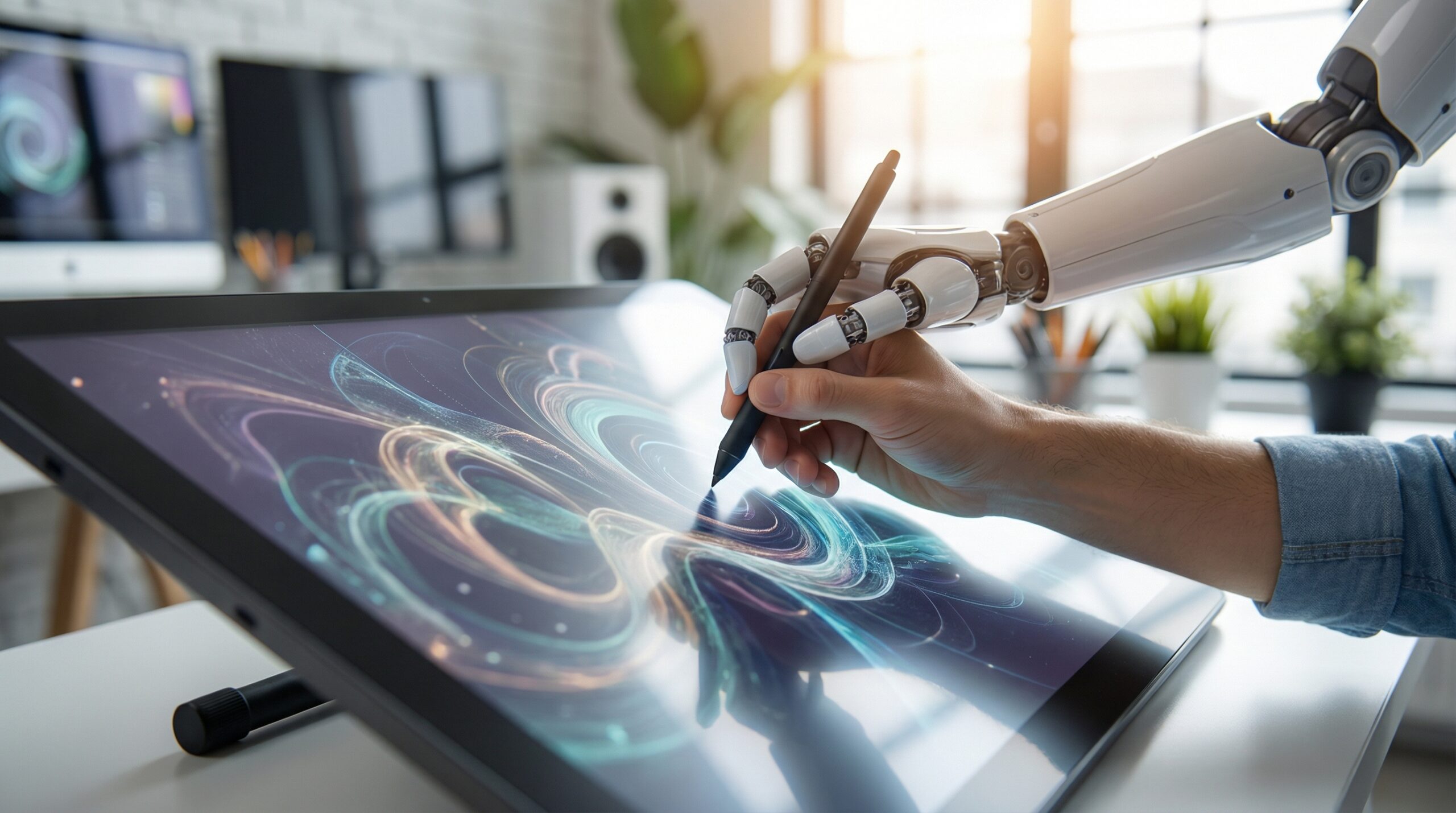
AI artists collaboration is opening a new creative era where human imagination and artificial intelligence work side by side. Instead of replacing artists AI is becoming a creative partner that helps generate ideas explore new styles and accelerate the creative process. From music and visual art to design and storytelling collaborations between artists and AI tools are reshaping how art is created shared and experienced.
How AI Can Help Artists: Transforming Creativity Through Collaboration
Estimated reading time: 7 minutes
- AI can boost productivity by up to 25%.
- AI helps generate diverse ideas, overcoming creative blocks.
- Collaboration with AI leads to innovative forms of expression.
- Artists utilizing AI can access a wealth of cultural insights.
- Adopting AI can transform traditional artistic workflows.
Table of Contents:
- Boosting Productivity and Enhancing Value
- Inspiring Idea Generation and Overcoming Creative Blocks
- Facilitating Creative Exploration and Novelty
- Expanded Capabilities for Artistic Expression
- Embracing the Human-AI Partnership Model
- Practical Takeaways for Artists
- Conclusion
Boosting Productivity and Enhancing Value
One of the most compelling advantages of integrating AI into artistic workflows is the significant boost in productivity it offers. Comprehensive research analyzing over 53,000 artists on major art-sharing platforms found that adopting text-to-image generative AI can increase creative productivity by 25%. Moreover, artwork value, as gauged by audience engagement metrics such as favorites per view, can rise by 50%. This data highlights the critical role of AI in allowing artists to focus on sophisticated creative tasks while managing repetitive, mechanical processes. By automating routine elements, AI supports artists in sculpting more engaging and value-rich creations.
Inspiring Idea Generation and Overcoming Creative Blocks
The creative process often involves overcoming blocks and generating fresh ideas. AI tools excel in this domain by analyzing vast datasets of artistic styles and generating diverse inspirations in mere seconds. Whether through platforms like Artbreeder or DeepArt, artists can blend various styles and ignite their imaginative spark, thus expanding their repertoire.
AI’s unique strength lies in its ability to form unexpected connections between concepts, producing compositions, color schemes, and visual references that artists may not independently consider. This capability fosters an environment of exploration and experimentation, allowing artists to iterate on their ideas and push the boundaries of their work without the traditional constraints of time and resources.
Facilitating Creative Exploration and Novelty
In the collaborative creative space with AI, artists experience a thrilling enhancement of their creative processes. Successful artists often find themselves blending their human ideation skills with AI’s ability to generate novel outputs—this symbiosis encourages them to explore new avenues they might not have otherwise considered.
Interestingly, while some studies indicate that the average novelty of artwork may decline when artists rely heavily on AI, those who strategically curate AI’s outputs often reap the most significant benefits. Researchers refer to this synergy as “generative synesthesia”—a unique interaction where human creativity harmonizes with AI’s computational power to yield innovative artistic workflows. By effectively filtering and refining AI-generated options, artists can maintain their creative voices while leveraging advanced technology.
Expanded Capabilities for Artistic Expression
AI is not just reshaping traditional art practices; it is also enabling entirely new forms of artistic expression that were once unthinkable. Here are some notable advancements:
- Visual Exploration: Artists are using AI-generated images as foundational elements, allowing the tech to create abstract patterns or evolving compositions that can be integrated into their work. This fosters an iterative design process, enabling artists to explore diverse visual languages.
- Music Composition: Musicians can harness AI to compose intricate melodies, harmonies, and full musical compositions. The potential for AI in music extends from creating suitable background scores to developing entirely new genres.
- Cross-Medium Innovations: Leading artists, such as Mario Klingemann, manipulate machine learning and AI technologies to create revolutionary aesthetics that challenge traditional definitions of art and beauty. This cross-pollination between mediums not only broadens artistic horizons but also enhances creative depth.

Embracing the Human-AI Partnership Model in ai artists collaboration
A critical takeaway from the exploration of AI in art is that the human-AI relationship shifts the focus of artistic creation. In this new landscape, human ideation and artistic filtering become paramount, highlighting the invaluable role of artists in the creative process. Instead of replacing creativity, AI serves as a collaborative ally that opens new realms of possibility, including:
- Access to Diverse Art Movements: By leveraging vast databases, artists gain unprecedented access to global trends, innovation, and historical art movements that influence their work.
- Rapid Iteration and Experimentation: AI enables swift experimentation with new techniques and mediums, accelerating the creative process and enhancing the overall quality of artistic output.
- Uncovering Hidden Connections: AI’s capacity to analyze and discern patterns across complex datasets allows it to reveal creative connections and concepts that may lie beyond the realm of human cognition.
The economic validation of AI’s role in the art world is illustrated by the sale of “Edmond de Belamy,” an AI-generated portrait that fetched $432,500 at a Christie’s auction, affirming that AI-assisted creations are not just a fleeting trend but a burgeoning facet of the contemporary art ecosystem.
Practical Takeaways for Artists
To effectively integrate AI into their artistic practices, artists may consider the following actionable steps:
- Experiment with AI Tools: Dive into platforms such as Artbreeder or DeepArt to start blending styles and generating fresh ideas. Don’t hesitate to experiment—trial and error can lead to exciting breakthroughs.
- Leverage AI for Repetitive Tasks: Identify repetitive tasks in your artistic workflow, such as resizing images or applying filters, and utilize AI tools to automate these processes. This will free up more time for you to focus on high-level creative concepts.
- Collaborate with AI: View AI as a creative partner rather than a replacement. Explore how AI can enhance your unique voice and style. Remember that the best results often come from filtering AI outputs through your sensibilities.
- Stay Informed: Engage with the ongoing conversations about AI in the arts. As technology evolves, being informed about new tools and methodologies will ensure that you remain at the forefront of artistic innovation.
- Embrace Community: Join forums or networks of artists exploring AI. Sharing experiences and insights with peers can foster innovation and create collaborative opportunities that enrich your practice.
Conclusion of ai artists collaboration
The intersection of AI and artistry represents a thrilling frontier for creative exploration. By harnessing AI, artists can significantly enhance their productivity, overcome creative blocks, explore new dimensions of expression, and foster an innovative collaborative relationship that is set to redefine the future of art. As we embrace this integration, it’s essential to remember that while AI can augment our artistic capabilities, the human touch remains irreplaceable—infusing creativity with emotion, meaning, and personal experience. As the world continues to explore these uncharted territories, the collaboration between human artists and AI promises to unlock vast dimensions of creativity waiting to be discovered.
FAQ
Q: How does AI affect artistic creativity?
A: AI enhances artistic creativity by providing new tools for idea generation, offering diverse inspirations, and allowing artists to focus on high-level creative tasks while it manages repetitive processes.
Q: Can AI replace human artists?
A: No, AI serves as a collaborative ally to artists, enhancing their capabilities rather than replacing their unique human creativity.
Q: What are some practical AI tools for artists?
A: Popular AI tools include Artbreeder, DeepArt, and various music composition software that utilize AI.